


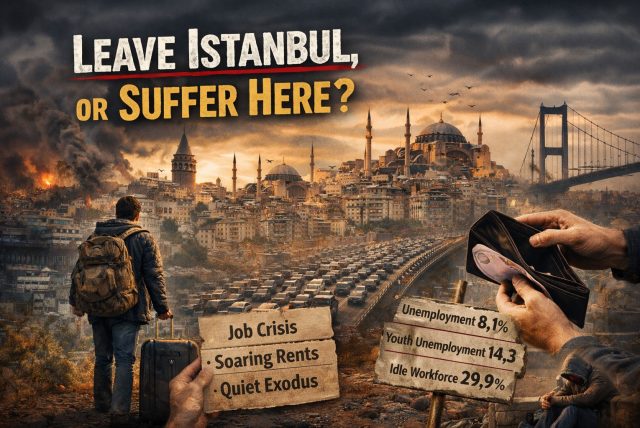
The economy in Turkey is no longer something that can be explained solely through charts, tables, and ratios. Numbers tell us one story, but people on the ground are living a completely different reality. For years, Istanbul was praised as the economic engine of Turkey—its job opportunities, high income potential, and social mobility made it highly attractive. But today, the reality we observe in the field has completely changed. People are no longer striving just to earn money, but to survive. They are working, yet unable to make ends meet; those who are not working are counted as unemployed, but in reality, many more are excluded from the system altogether.
According to the latest data, the unemployment rate in Turkey stands at 8.1%, with approximately 2.819 million unemployed individuals. At first glance, this may seem “not too bad.” Some even compare it to European countries and consider it relatively low. However, the reality behind these official figures is far more striking. The unemployment rate only includes individuals actively seeking jobs. Those who have lost hope, those working in low-paying jobs outside their field, young people struggling with part-time work, and individuals alienated from the system are all excluded from these figures. When these groups are taken into account, the perceived level of unemployment is far higher, and the crisis on the ground is much deeper.
Youth unemployment is particularly alarming. Among individuals aged 15–24, the unemployment rate is 14.3%—11.9% for young men and nearly 19% for young women. But the real issue is this: in Turkey, one in four young people is neither employed nor in education. In other words, they have diplomas, but no place within the system. A university graduate who speaks two languages is still searching for a job at minimum wage level—and this is no longer the exception; it has become the norm. For young people, this is not only an economic burden but also a psychological one. Despite completing their education, they realize the system fails to position them properly, leading to deep frustration and hopelessness.
The labor force participation rate stands at just 52.1%, meaning half of the population is already outside the system. The other half is working but unable to sustain a decent standard of living. When we look specifically at Istanbul, the situation becomes even harsher. While the city is still considered Turkey’s economic engine, it is no longer a city of opportunity—it has become a test of endurance. Average salaries range between 25,000–35,000 TL, while rents alone range from 15,000–25,000 TL. When other living expenses are added, most people’s income simply does not cover their costs. People are working, but merely to survive rather than to truly live.
This economic pressure in Istanbul has also triggered a wave of migration. White-collar workers who can work remotely are increasingly moving to smaller cities. The middle class, small business owners, and newly married couples are no longer choosing Istanbul. Cities like Tekirdağ, Balıkesir, Çanakkale, and quieter regions of Central Anatolia are becoming new centers of life. People want to earn the same income but enjoy a more livable and comfortable lifestyle. This migration is not a traditional form of job or education migration—it is driven by economic necessity and quality of life. People are now prioritizing not just income, but also living standards and psychological well-being.
The psychological state of those living in Istanbul further intensifies the picture. People are working, yet they do not feel secure. Questions like “Will I lose my job tomorrow?”, “How long can I survive on this salary?”, and “Is it even possible to plan for the future?” are constantly on their minds. This phenomenon can be described as “psychological unemployment”—an unmeasured but widespread crisis. Even those who are employed feel disconnected from the system, leading to a sense of burnout.
Beyond unemployment and living costs, the social fabric of Istanbul is also changing. The very elements that once made the city attractive are becoming increasingly burdensome. Heavy traffic, high rents, expensive social activities, and rising basic living costs are weakening people’s connection to the city. People are beginning to say: cities should serve people, not the other way around. Returning to nature or moving to smaller cities is no longer a trend—it has become an economic necessity.
Will Istanbul be completely emptied within the next 10 years? No, it will not. However, its population profile will change. The wealthy and those who must remain will stay, while the middle class and young professionals will gradually leave. Istanbul will remain a megacity, but it will cease to be a city for the middle class. People are increasingly choosing to build better lives in smaller cities rather than struggle in a metropolis.
The future of Istanbul will not be defined solely by its population size, but by the relationship that population has with the city. Istanbul still stands out with its scale and economic power, and it continues to offer job opportunities. However, in terms of quality of life for the middle class and young people, its attractiveness is steadily declining. As people seek places where they can earn similar incomes with lower costs, the demographic structure of Istanbul will continue to shift.
From the perspective of a financial advisor, the conclusion is clear: Istanbul remains an economic center, but due to high living costs and labor market dynamics, it is no longer an ideal city for the middle class and young people. Official unemployment stands at 8.1%, youth unemployment at 14.3%, and the underutilized labor force at 29.9%. The numbers tell one part of the story, but the reality on the ground is much harsher. People are working but cannot make ends meet, young people are unemployed despite their education, and the middle class is leaving the city. Istanbul’s economic power will endure, but its spirit—and its middle class—is gradually fading.
In conclusion, Istanbul will not become empty overnight, but it will continue to lose people year by year, and it will not remain the same. People are no longer planning how to live in the city, but how to leave it. Economic decisions are now driven by quality of life and psychological well-being. Istanbul is still the heart of Turkey—but the rhythm of its middle class and young population is slowly fading.

